

How To Load An Index Value To A Register In Mips
Assembly tin can exist a tough language to wrap one's caput around. It's nitty, it's gritty, and can be tricky to debug. The Microprocessor without Interlocked Pipelined Stages (MIPS) architecture is a simplified language that many universities utilise as an introduction to assembly.
- i Store Discussion (SW)
- ii Load Give-and-take (LW)
- 3 Summary
While MIPS is considered a Reduced Educational activity Set Computer (RISC) it can nevertheless exist difficult to go familiarized with. Two of the basic operations available to programmers are the Store Word (SW) and Load Word (LW) commands. These commands are used to retrieve (load) and relieve (store) values from specified memory locations.
Store Word (SW)
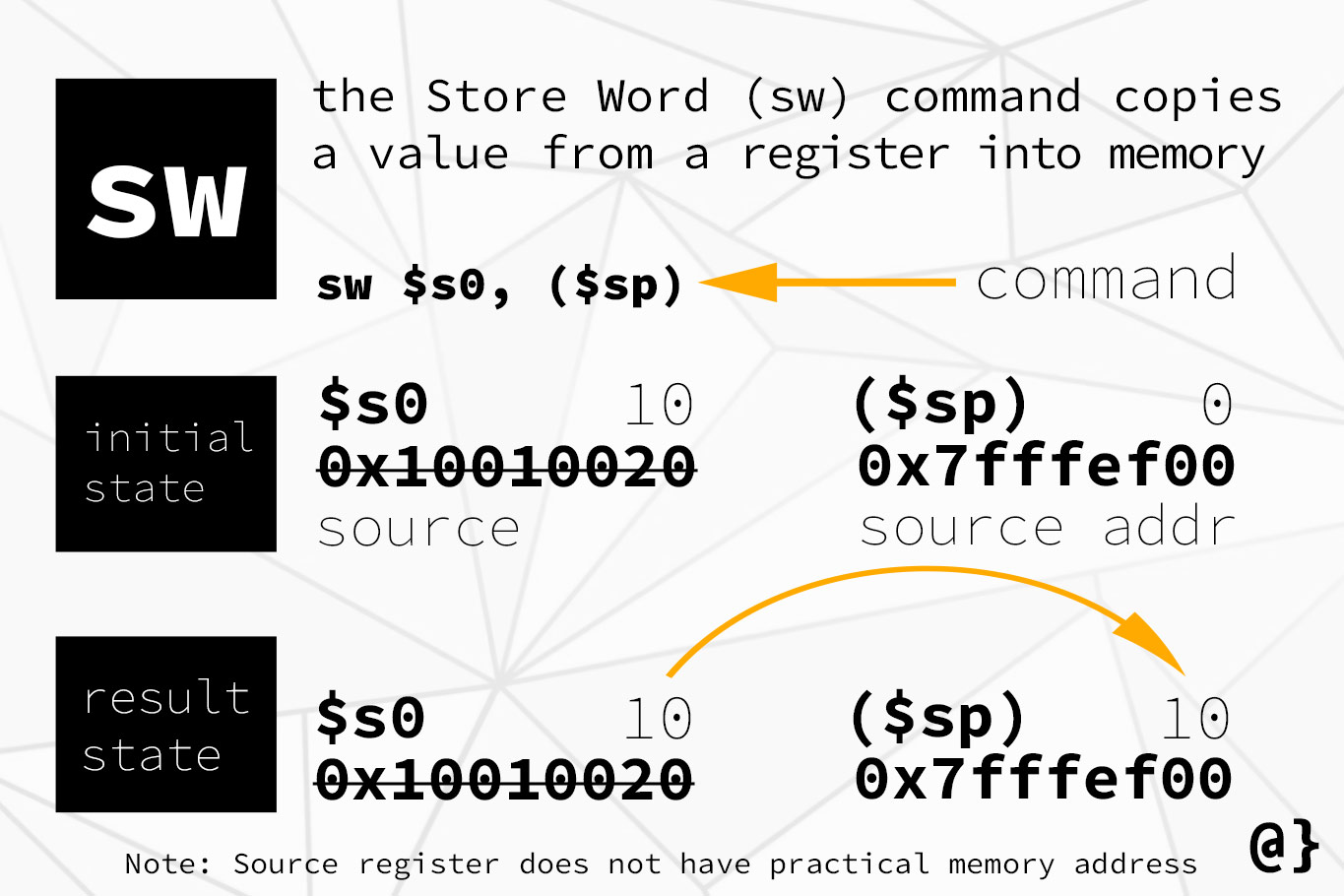
The MIPS SW command has the following instruction signature: sw, $source, starting time($destination) where:
-
swis the command; -
$destinationis the register in which to relieve the value; -
offsetis the memory get-go; -
$sourceis the base accost.
This command instructs the CPU to have whatsoever value is stored at memory location $source and copy it to the memory location at $destination.
TL;DR – sw gets a value from a register and puts into memory
Load Word (LW)
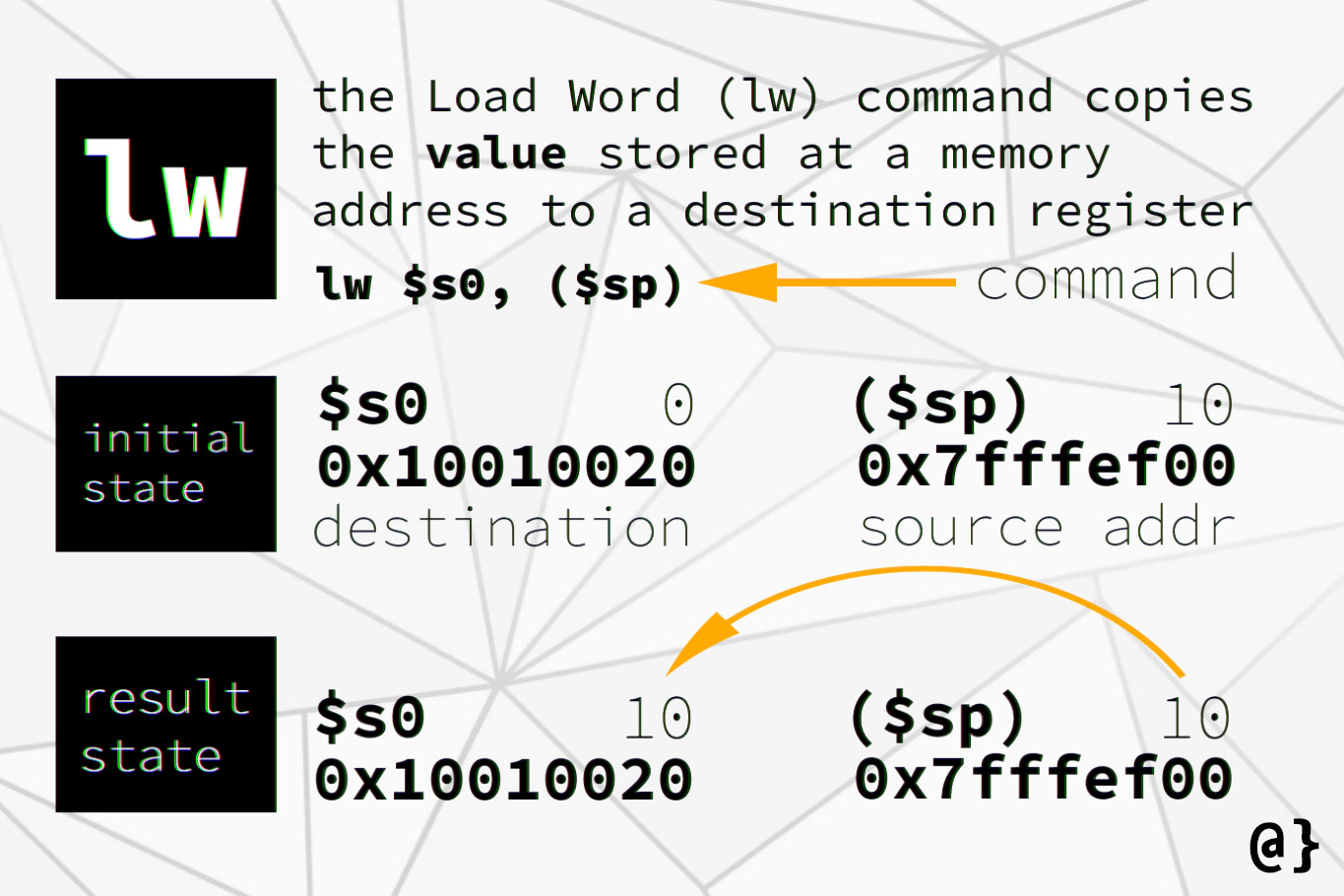
The MIPS LW command has the following signature: lw, $destination, start($source) where
-
lwis the control; -
$destinationis the annals to which the value is to be stored; -
starting timeis the retentivity beginning; -
$sourceis the base of operations address from which data is retrieved.
This command instructs the CPU to accept whatever value is held in the $source register and save information technology into retentivity at the $destination accost.
TL;DR – lw gets a value from retention and puts into a register
Summary
MIPS is a bang-up language to learn the nuts of assembly programming. The MIPS32 architecture helps expose a RISC ready of instructions in a reduced memory setting which helps simplify things further. Basically, one wrangles 32-bit memory addresses during debugging rather than 64-bit addresses.
The sw and lw commands in MIPS are essential to loading and saving values from registers and memory locations. Agreement the fundamental actions of these commands can help pave the way to basic operations such as loading values into arrays, copying arrays, and preparing registers for process calls.

How To Load An Index Value To A Register In Mips,
Source: https://www.alpharithms.com/mips-store-word-sw-vs-load-word-lw-475521/
Posted by: hatchelltionot61.blogspot.com
0 Response to "How To Load An Index Value To A Register In Mips"
Post a Comment