

How Many Black People Are Registered To Vote In Nj
No Racial Requirement
Gratuitous Voters of Color in New Bailiwick of jersey
There were simply three state constitutions from 1776 to 1790 — Georgia until 1789, South Carolina, and Virginia — that defined voters equally "white." By 1807, Delaware, Maryland, Ohio, and New Jersey were added to that list.
Between 1776 and 1807, New Jersey's State Constitution used the gender-neutral pronoun "they" and did not include racial categories in its ballot law. This opened the electorate to any man or woman, Blackness or white, that could run across the property, residency, and age requirements.
Gratuitous people of African descent could and did vote in New Jersey earlier 1807. Poll lists, however, rarely record whether a voter was Black or white. In fact, only ane of the nine known pre-1807 New Jersey poll lists discovered by the Museum explicitly identifies a Blackness voter — Ephraim Hagerman of Montgomery Township, Somerset County, in October 1801. Tax lists from the 1790s confirm that Hagerman was a gratuitous person of color, but they too show that the value of his holding does not announced to have met the 50 pound belongings requirement needed to vote. It is possible that his payment of taxes, regardless of the value of his property, qualified him to vote.
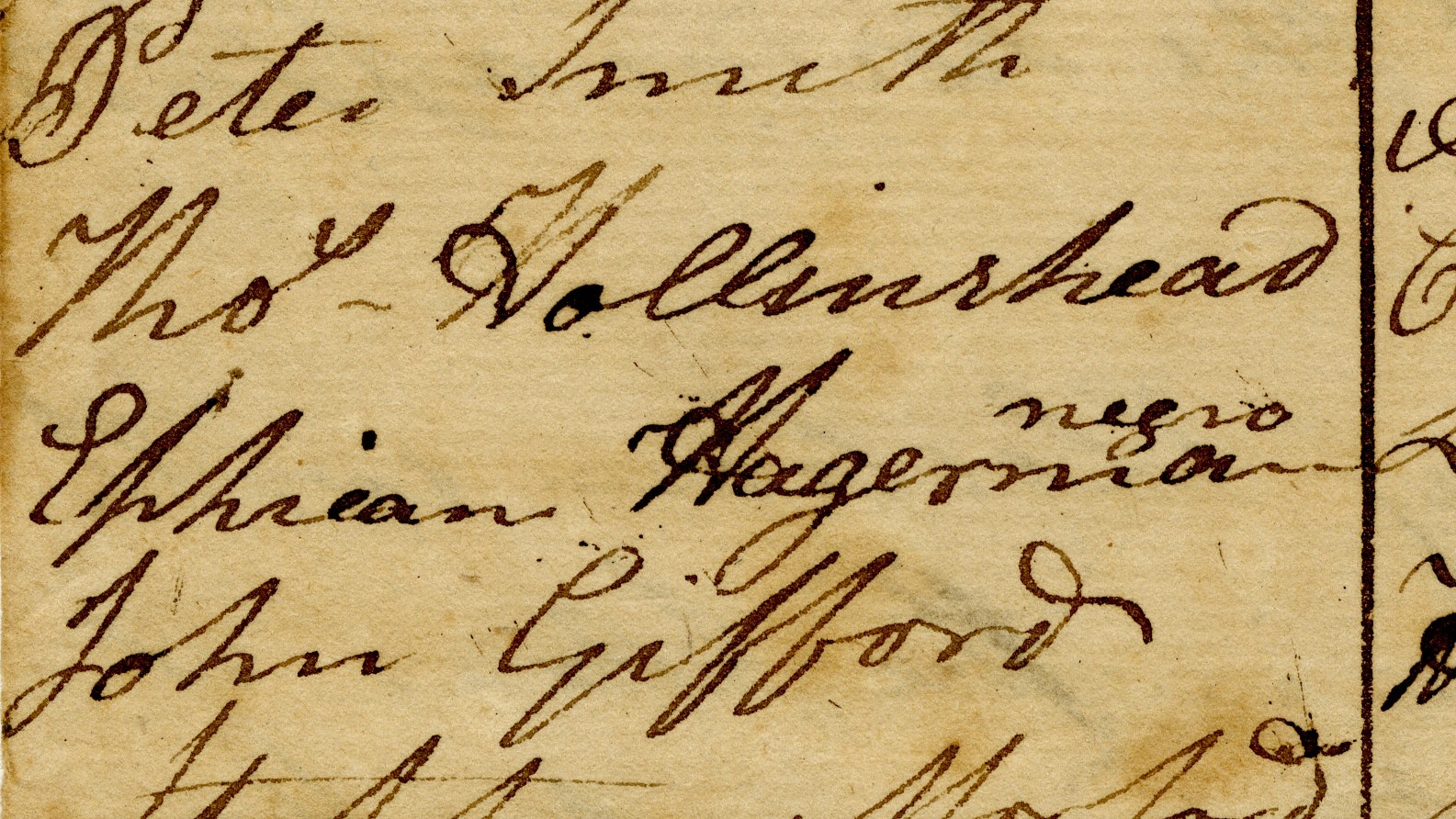
Ephraim Hagerman is the but Black person identified past the word "negro" on the October 1801 Montgomery Township Poll List. New Jersey Country Athenaeum, Section of State
While no other Black voters are specifically identified past their race on surviving pre-1807 poll lists, their racial identities tin can be confirmed when comparing their names in other primary source documents, such equally tax lists. For case, a human being named Thomas Blue voted in the same 1801 Montgomery Township election every bit Ephraim Hagerman. The but Thomas Blue to announced on township taxation lists from the years surrounding 1801 is a free Black man named Thomas Blue who had been formerly enslaved by Michael Blew, a farmer of Dutch descent in Blawenburg, Somerset Canton. A Montgomery Township taxation list from 1802 describes Thomas Blue as Black with the give-and-take "Negro" adjacent to his proper name. Thomas Bluish was freed past the Blew family unit in 1788 and lived in the township until virtually 1805.
In improver to Ephraim Hagerman and Thomas Blue, the Museum has identified at least three other free Black men who voted in early New Jersey, and perchance one gratis Blackness woman, Judith or "Jude" Bluish , the wife of Thomas Bluish. Similar her husband, Judith Blue had probably been enslaved by Michael Blew in Somerset County.

Thomas Blueish is listed as "Negro" on the 1802 revenue enhancement list for Montgomery Township. New Jersey State Athenaeum, Department of State
Withal, slavery was nevertheless legal in New Jersey until it was completly abolished by the 13th Amendment to the Usa Constitution in 1865, making for cruel contradictions between the promise of the American Revolution and the realities of slavery for many of the state's inhabitants. The voting eligibility of people of color in New Jersey depended on their status every bit either belongings or property owners. Enslaved people were considered property and could not vote. The value of one enslaved woman in New Bailiwick of jersey was approximately l pounds in the 1790s, exactly the amount of property value needed to vote.
Although New Jersey banned the importation of enslaved people in 1786, populations of enslaved people in East Jersey grew over the 1790s. They were typically concentrated in counties such as Monmouth, Bergen, and Somerset. Somerset County, for case, where Ephraim Hagerman and at to the lowest degree four other free people of color voted in 1801, was abode to near 2,000 enslaved people in 1790 and only 147 free people of color. Past 1800, at that place were 12,422 enslaved people in New Bailiwick of jersey compared to an estimated 4,402 free people of colour.
It took until 1804 for New Jersey to adopt any grade of gradual abolition, making information technology the terminal northern state to exercise so. Many people of African descent lived in slavery, alongside complimentary people of colour who owned belongings and could vote until that right was taken away from all people of color in 1807.
Simply people of color — men and women — were undoubtedly present at polling places in the 18th and early-19th centuries. In New Jersey, the question is whether they were there as property owners legally exercising their correct to vote, or, if they were there as enslaved people, accompanying their owner to testify his or her voter eligibility.

Source: https://www.amrevmuseum.org/virtualexhibits/when-women-lost-the-vote-a-revolutionary-story/pages/no-racial-requirement-2
Posted by: hatchelltionot61.blogspot.com
0 Response to "How Many Black People Are Registered To Vote In Nj"
Post a Comment